
Many organizations assume compliance problems are technical. If the right security tools are installed and the correct controls are configured, they expect audits to go smoothly.
In reality, most compliance failures are not caused by missing technology. They happen because governance is unclear. Policies exist but are not maintained. Security controls are implemented but not regularly validated. Documentation exists somewhere, but no one can quickly produce it when an auditor asks for it.
The result is a familiar pattern. Each audit cycle becomes a scramble to gather evidence, explain decisions, and close the same gaps again. What should be a structured process turns into operational disruption.
This is why more organizations are adopting a governance-first approach through Compliance as a Service.

Why Governance Determines Compliance Outcomes
Most security frameworks assume governance already exists.
Standards such as NIST 2.0 and regulations like the FTC Safeguards Rule require organizations to demonstrate not only that security controls exist, but that they are monitored, reviewed, and documented over time. Auditors are looking for evidence that risk decisions are managed intentionally, not just that technology is deployed.
This means organizations must be able to answer simple but critical questions:
Who owns this control?
When was it last reviewed?
Where is the policy documented?
How are exceptions tracked?
Many organizations struggle here. According to PwC’s Global Risk Survey, 55% of organizations say regulatory and compliance requirements have become significantly more complex in recent years. Without a governance structure, those expectations quickly overwhelm internal teams.

When Compliance Ownership Is Unclear
In many environments, compliance responsibilities evolve informally. Internal IT teams manage security tools and infrastructure, while leadership assumes policies and documentation are being handled somewhere else.
Over time, gaps appear.
Security policies may not reflect the current environment. Control reviews may not happen consistently. Documentation may be scattered across systems, spreadsheets, and shared folders. These issues often remain invisible until an IT audit begins asking for evidence.
At that point, organizations are forced into reactive compliance work.

The Problem of Audit Fatigue
When governance is weak, compliance becomes repetitive.
The same findings appear across multiple audits because no one is responsible for permanently resolving them. Internal teams spend weeks assembling documentation simply because information is spread across different systems and departments.
This leads to what many organizations describe as audit fatigue. Instead of improving security posture, teams spend significant time preparing for the next review.
Research supports this reality. Gartner estimates that organizations spend 30–40% of security team time on compliance-related activities, much of it focused on documentation and audit preparation rather than actual risk reduction.
The issue is rarely the absence of security tools. It is the absence of structured governance.

A Governance-First Model for Compliance
Compliance as a Service addresses this challenge by establishing an ongoing governance structure around security and risk management.
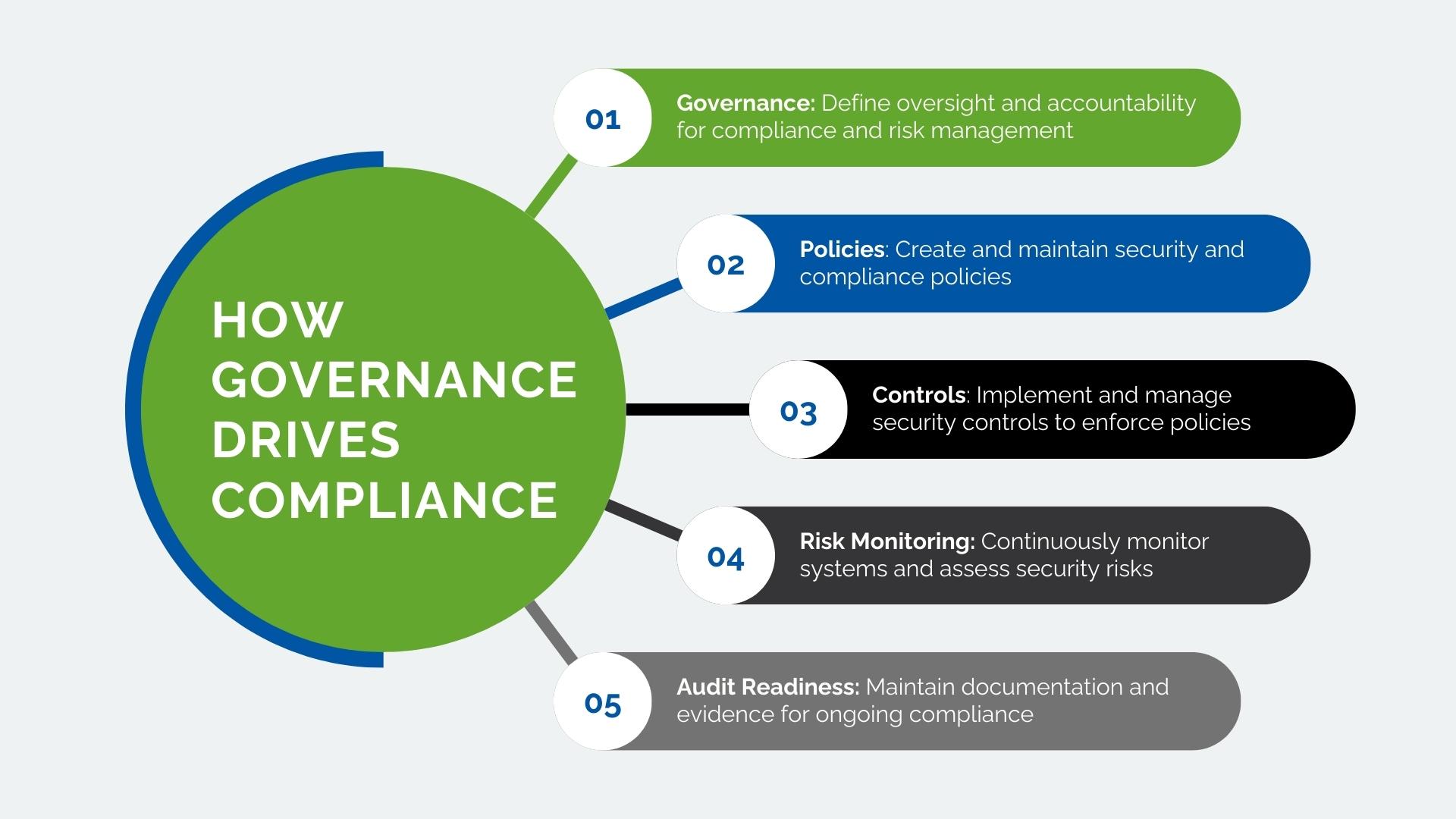
Rather than treating compliance as a one-time project, organizations maintain continuous oversight of policies, controls, and documentation. Compliance becomes part of normal operations instead of an event triggered by an upcoming audit.
This governance layer typically includes defined ownership of controls, regular policy reviews, documentation management, and framework alignment with standards such as NIST. When these elements are maintained consistently, organizations remain audit-ready throughout the year.
The outcome is not simply passing audits. It is maintaining clarity around risk, accountability, and security operations.
Why Governance Matters for Small and Mid-Sized Businesses
Governance challenges are particularly common in small and mid-sized organizations. Internal IT teams often focus on operational priorities such as infrastructure stability, user support, and system performance.
Compliance frameworks, however, require ongoing documentation, policy management, and risk oversight. Without a defined governance structure, these responsibilities can easily fall through the cracks.
This matters because smaller organizations remain a primary target for cybercrime. Verizon’s Data Breach Investigations Report shows that more than 60% of cyberattacks involve small and mid-sized businesses. Many of these organizations struggle with fragmented compliance processes and limited governance oversight.
A structured compliance approach helps reduce these risks by ensuring security and documentation practices remain aligned over time.

Compliance Should Reduce Risk, Not Create Work
When governance is clear, compliance becomes predictable. Documentation is maintained continuously rather than rebuilt before every audit. Security controls are reviewed regularly instead of rediscovered during assessments.
Instead of creating operational disruption, compliance becomes a mechanism for maintaining visibility into risk and accountability across the organization.
Passing an audit should not be the objective of compliance efforts. It should be the natural result of strong governance.
Organizations that approach compliance this way reduce audit fatigue, maintain alignment with evolving standards, and create a more resilient security posture over time.
Let’s Connect
If your organization is preparing for an IT audit, aligning with the FTC Safeguards Rule, or implementing NIST 2.0 compliance, governance clarity is often the missing piece.
CorCystems can help review your current governance structure and identify where compliance oversight can be simplified and strengthened.