Even though Cybersecurity Awareness Month has passed, the message behind it still matters. You already know the value of strong passwords, phishing alerts, and regular training. What’s tougher—and more urgent—is proving that your business actually operates in a safer state. Insurers, regulators, and even your board increasingly expect hard evidence that you’re managing risks, not just talking about them.
According to the 2025 State of Cyber Risk Management report by the FAIR Institute, nearly half of mature organizations quantify cyber risk in financial terms, and more than 90% of those who adopt that approach report success in aligning risk programs with business goals. That shift matters: awareness still helps, but to earn trust and favor from underwriters or examiners, you must move to measurable oversight.
That’s where a structured tool such as an IT audit comes into play. When you review your systems, controls, and policies against clear standards, you produce more than comfort, you create records that show exactly how prepared your business is. Awareness is a useful start. But measurable governance is what keeps your organization resilient, trusted, and verifiable.

Awareness vs. Measurable Action
Cybersecurity awareness campaigns remind employees to be careful, but reminders alone don’t reduce exposure. You may tell staff to watch for suspicious links, but if accounts lack multifactor authentication (MFA), the risk of unauthorized access remains high. Awareness highlights the issue. Action, backed by measurement, addresses it.
The distinction is important. For example, you might know that patching outdated systems reduces risk. But unless you can show that 95% of your servers and endpoints are updated within 30 days, it’s difficult to prove your true level of protection. The same applies to backups. Everyone knows they’re important, but unless you test and confirm that backups restore properly, you can’t be sure they’ll support you during an incident.
Awareness on its own is not enough to satisfy insurers, regulators, or customers. They need proof. And proof only comes when you measure what has been done.

What an IT Audit Really Means
An IT audit is a structured review of your technology environment. It doesn’t focus on every technical detail. It focuses on whether your systems, policies, and practices align with recognized standards of security and compliance.
This type of audit examines areas such as:
- Identity and Access Controls: Are MFA and role-based permissions enforced consistently?
- Patching Cadence: How quickly do you update systems when new vulnerabilities are found?
- Backup and Recovery Readiness: Are backups not just taken, but tested for usability?
- Incident Response Planning: Do you have a documented plan that’s been exercised, not just written?
The goal is not to pass or fail, but to create benchmarks. These benchmarks allow you to measure progress over time and show external stakeholders that you’re managing risks with discipline.
Think of it as a financial audit for your technology. Just as you would want clarity in your books to guide financial decisions, an IT audit helps guide decisions around security, compliance, and insurance coverage.
The Metrics That Matter
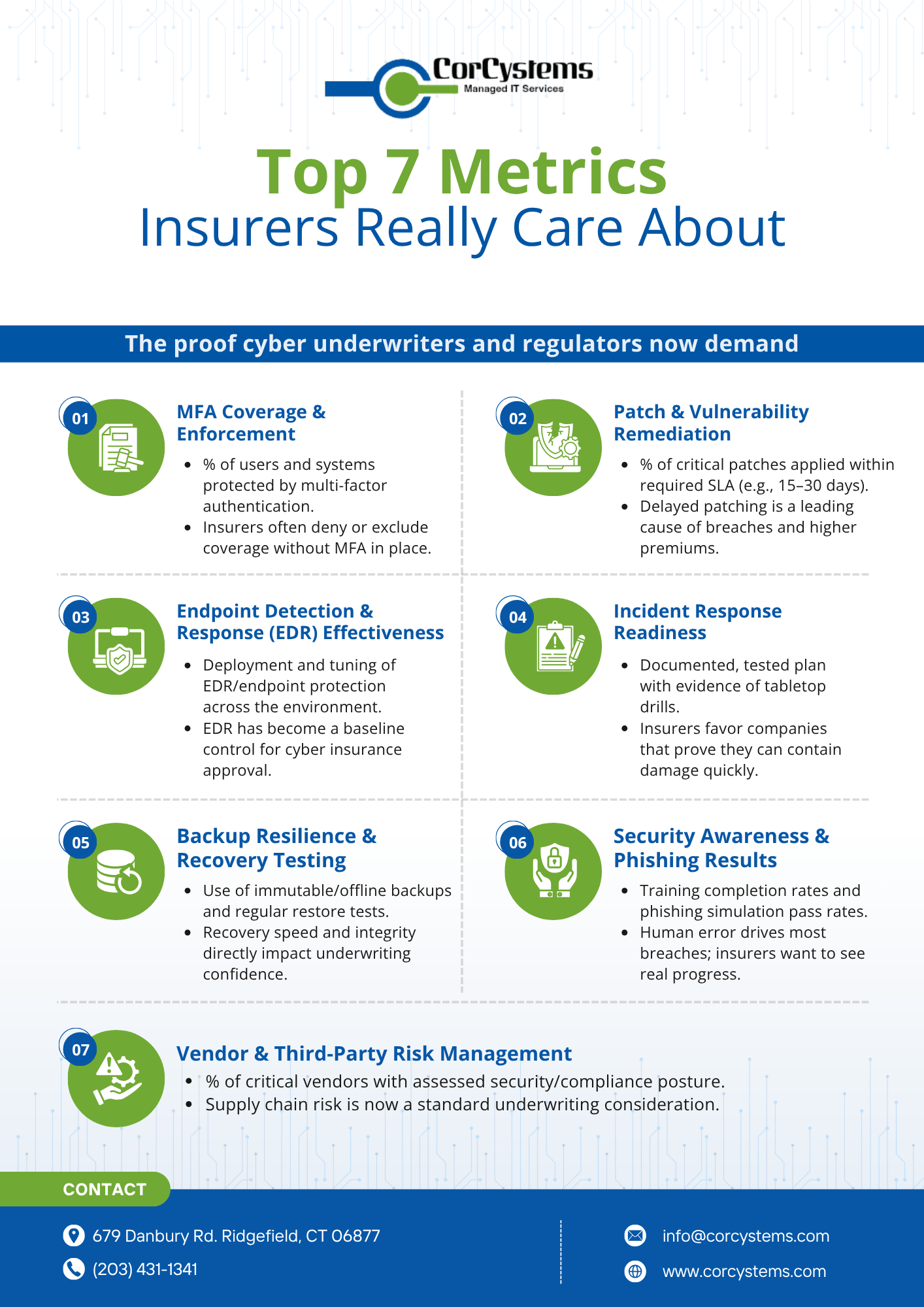
When it comes to measuring cybersecurity risk, not every metric carries the same weight. Some numbers provide surface-level information, while others directly reflect the strength of your defenses. The metrics that matter most are those that show how well your organization can prevent, detect, and respond to incidents.
Identity & Access
- Percentage of accounts protected by MFA.
- Number of privileged accounts and how often their usage is reviewed.
Insurers consistently cite MFA as one of the top factors in underwriting. Studies from Marsh McLennan and ProWriters highlight that organizations without it face higher premiums or outright coverage denials.
Resilience
- Backup success rates across systems.
- Average time it takes to restore critical data during tests.
IBM’s 2024 Cost of a Data Breach Report shows that organizations with reliable backup and recovery strategies reduce downtime and overall costs significantly.
Response Readiness
- Mean time to detect and respond to incidents.
- Documentation of at least one annual tabletop exercise.
The same IBM report confirms that companies with rehearsed response plans save millions in breach costs compared to those without.
Patching & Updates
- Percentage of systems updated within 30 days of release.
Verizon’s 2024 Data Breach Investigations Report points out that patching delays remain one of the top contributors to breaches, often leading to avoidable incidents.
These metrics aren’t just numbers. They are direct indicators of business risk. They also create evidence that external reviewers can easily understand.

Why Proof Matters to Insurers, Auditors, and Regulators
Cybersecurity today is as much about accountability as it is about protection. Insurers, auditors, and regulators all require different forms of evidence to evaluate your posture.
Insurers
Premiums and coverage decisions increasingly depend on your ability to show controls like MFA, endpoint detection and response (EDR), and tested backups. Reports from At-Bay and Marsh McLennan make clear that underwriters are scrutinizing these factors before issuing or renewing policies. Businesses that can’t provide proof often face higher costs or denied coverage.
Regulators
In industries such as finance and healthcare, regulators demand compliance with standards like HIPAA, PCI DSS, and the FTC Safeguards Rule. An audit provides the documentation that examiners expect to see during reviews. Without it, compliance efforts can appear incomplete or unreliable.
Auditors and External Partners
Third parties often use external ratings, such as those published by BitSight, to assess your organization’s cyber hygiene. These ratings can affect vendor relationships, contracts, and even customer trust. Demonstrating documented practices through internal audits strengthens your standing and ensures that external ratings align with reality.
Proof doesn’t just satisfy requirements. It reduces costs, protects business relationships, and builds confidence among stakeholders.
Building Documentation That Stands Up to Scrutiny
Good security practices only carry weight when you can show evidence. Documentation provides that evidence. It also gives your team clarity and ensures consistency in execution.
Examples of effective documentation include:
- Backup Verification Logs: Showing the results of regular restoration tests.
- MFA Enforcement Reports: Listing accounts and confirmation of policy enforcement.
- Incident Response Records: Notes from tabletop exercises or after-action reviews.
- Patch Management Summaries: Reports on update success rates across systems.
This documentation doesn’t need to be complicated. It just needs to be accurate, consistent, and accessible. Having it in place also prepares you for outside scrutiny, whether during an insurance renewal, a compliance audit, or a client review.
Think of documentation as a form of insurance itself. It reduces disputes, clarifies accountability, and provides a foundation for continuous improvement.

Aligning Cybersecurity Practices with Ongoing Compliance
Cybersecurity Awareness Month may be over, but the work it represents continues year-round. Every organization needs consistent checkpoints to review security posture, validate documentation, and confirm measurable progress. Treating this as an ongoing cycle, rather than a once-a-year campaign, turns awareness into true accountability.
Use the end of each year as a natural checkpoint to:
-
Review your last IT audit and schedule the next one.
-
Evaluate whether key security metrics improved.
-
Update documentation for policies, backups, and incident response.
-
Communicate measurable results to executives, insurers, or regulators.
This approach keeps awareness alive beyond October, embedding it into your governance rhythm, much like annual financial reporting or tax preparation.
Turning Awareness Into Proof
Awareness campaigns come and go, but measurable oversight is what truly protects your organization. If you haven’t yet turned this year’s awareness efforts into action, now is the perfect time to start.
Book a call with our experts to learn how structured audits and measurable governance can strengthen your security posture for the year ahead.